How hydroponics actually works, explained for people who have never tried it
Share
The word sounds like a laboratory. In practice hydroponics is the least complicated way to grow a plant ever invented, and the confusion comes from one wrong assumption: that soil is the thing plants eat.
It is not. Soil is a delivery system. Understand what it delivers and hydroponics stops being mysterious.
What plants actually take from the ground
A plant builds itself almost entirely out of air and water. The carbon in a leaf comes from carbon dioxide; the hydrogen and oxygen come from water. Photosynthesis assembles those into sugars using light energy. That is the bulk of the plant.
The roots supply a short list of dissolved minerals — nitrogen, phosphorus, potassium, calcium, magnesium and sulphur in larger amounts, iron, manganese, zinc, copper, boron and molybdenum in traces. A root cannot absorb a lump of anything; each must be dissolved as an ion before it can cross into the root.
Which means a plant growing in soil is already growing hydroponically. The soil holds water, minerals release slowly into it, and the roots drink the solution. Soil is a reservoir, a buffer and an anchor — not an ingredient. Hydroponics removes the reservoir and gives the roots the solution directly. Nothing about the plant's chemistry changes.
What the nutrients are, and why there are two bottles
Hydroponic nutrients are simply those minerals, in measured proportions, in a form that dissolves — the same elements a bag of compost releases over months, supplied deliberately instead of by decomposition.
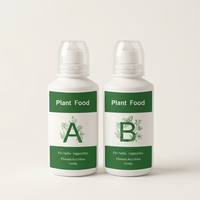
They usually come as two parts, A and B, and there is a genuine chemical reason. At concentrate strength, calcium and sulphate ions react to form calcium sulphate, which is barely soluble; the same problem arises between calcium and phosphates. Mixed in a bottle they would precipitate into a chalky sludge and be lost to the plant. Kept apart until they hit a full tank of water, they are diluted enough to stay in solution.
This is why the instruction is always to add A and B separately to water that is already in the reservoir, rather than combining the concentrates first. It is the one step where the chemistry genuinely matters.
Why the roots don't drown
This is the question everyone asks, and a good one, because overwatering really does kill houseplants.
Roots respire. They need oxygen to release the energy for pulling minerals in against a concentration gradient — active transport is expensive work. When a potted plant is overwatered, water fills the air pockets between soil particles and microbes consume the remaining dissolved oxygen fast. Oxygen diffuses through water far more slowly than through air, so it is not replaced. The roots suffocate, then rot sets in.
Water culture avoids this several ways at once. There is no soil, so no microbial population races the roots for oxygen. Fresh water carries dissolved oxygen. And the root mass is not entirely submerged: upper roots sit in the humid air gap below the plant and breathe directly, while lower roots drink. Plants grown in water from seed also develop roots adapted to it, with more internal air space than the same species in a pot.
What does cause trouble is stagnant water. Warm, unchanged solution loses its oxygen and grows the wrong bacteria — that is when roots turn brown and slimy. Changing the solution every couple of weeks is not housekeeping; it keeps the roots aerobic.
The rest of the setup
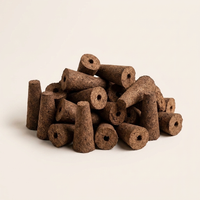
A growing medium — a pouch, a plug, a cube of inert material — holds the seed at the right height and keeps it damp until roots reach the water. Scaffolding, not food.
Acidity matters more than beginners expect, because nutrients only stay dissolved and absorbable within a mildly acidic range. Most European tap water lands close enough that herbs will not complain, which is why countertop units do not ship with a pH meter.
That is the entire system: water, dissolved minerals, air at the roots, light overhead.
What hydroponics is genuinely not good at
Every honest account should include this part.
- It does not solve light. Roots in perfect solution are useless if the leaves are in a dim room. Light is almost always the limiting factor indoors, and no nutrient mix compensates.
- Root crops are a poor fit. Carrots, potatoes, beetroot and onions want depth and something to push against. Possible in specialised systems, not on a worktop.
- Staple crops make no economic sense. Wheat, maize or potatoes grown indoors cost far more in electricity than the food is worth. Hydroponics excels at what is expensive per gram, perishable and eaten fresh — hence herbs and salad leaves.
- Large fruiting plants outgrow small systems. A full tomato plant needs a large reservoir, support and a lot of light. Compact chillies work on a counter; a beefsteak tomato does not.
- It is not zero maintenance. The water level drops faster than you expect, and the solution needs a full change on a rhythm. With no soil to buffer it, a small system is less forgiving of three weeks of neglect.
- It will not taste like a summer garden tomato. Flavour in fruiting crops owes much to sunlight intensity and temperature swings an indoor unit does not reproduce. Leafy herbs are the opposite case — often better than shop-bought, because they are cut minutes before use.
So is it hard?
The growing is not hard. The parts people get wrong are almost always the same three: not enough light, topping up with nutrient solution instead of plain water so the concentration creeps up, and leaving the same water in the tank for two months.
Get those right and the plant does the rest, faster than it would in a pot, because it never has to hunt for anything. The Gardenia GrowPod is built around that division of labour — it holds the water and supplies the light on a consistent cycle, leaving you the two-week rhythm of changing the solution and the pleasant part of cutting the herbs.