Why your herbs die every winter in Central Europe — and what actually fixes it
Share
Every October the same thing happens. The basil that was unstoppable in August turns pale, drops its lower leaves and gives up around the second week of November. The supermarket pot bought to replace it lasts eleven days. By January most kitchens have quietly stopped trying.
This is not a gardening skill problem. It is a light problem, and a specifically Central European one — the same whether you are on a fourth floor in Vienna, a converted attic in Graz, or a north-facing flat in Hamburg. Once you know which of the three winter factors is killing your herbs, the fix is boring and reliable.
The first problem: there simply is not enough day
At the December solstice, Vienna and Munich get somewhere around eight and a half hours between sunrise and sunset. Berlin and Hamburg, further north, get less than eight. That is the theoretical maximum, before you subtract the overcast days that dominate a Central European winter, and before you subtract the hours you spend at work with the blinds half closed.
Plants do not measure light the way we do. Our eyes adapt so aggressively that a room can feel bright while delivering a tiny fraction of what a plant received outdoors. A basil plant needs a certain total light energy per day to build new tissue. Below that threshold it does not simply grow slowly — it runs a deficit, cannibalising older leaves to keep the growing tip alive. That is what the yellowing lower leaves are telling you.
The second problem: the sun is in the wrong place
Day length is only half of it. In midwinter at these latitudes the sun never climbs high — at noon in December it sits under twenty degrees above the horizon in Vienna and Munich, and lower still in Berlin and Hamburg. Low-angle light arrives through a much thicker slice of atmosphere, so it is weaker to begin with, and it comes in almost sideways.
Practically, that means the buildings across the street matter enormously. A window that received hours of direct sun in June can receive none at all in January because the sun never rises above the roofline opposite. In the dense Gründerzeit blocks of Vienna or the courtyard flats of Berlin, whole facades sit in permanent shadow for months. A south-facing window is genuinely better, but “south-facing” in a courtyard is not the same thing as south-facing.
This is why the standard advice — move it to the brightest windowsill — often changes nothing. There may not be a bright windowsill in the building.
The third problem: dry heat
From October onwards, heating runs. Central heating and radiators drive indoor relative humidity down sharply, and the classic herb position is directly above a radiator on a windowsill, which is close to the worst possible microclimate: hot dry air rising past the leaves, a cold draught coming through the glass behind them.
A plant under light stress cannot afford to lose water quickly. Leaf edges crisp, and it closes its stomata to conserve moisture — which also stops the intake of carbon dioxide it needs to photosynthesise. The stresses compound.
Why the supermarket pot was never going to make it
It is worth being clear about what those pots are: grown fast under intense light in a professional glasshouse, with many seedlings crowded into one pot to look full at the point of sale. They are cut herbs that happen to still be attached to roots — a product with a shelf life, not a plant with a future.
Bring one home to a January flat and it is asked to survive on a fraction of the light it was raised under, with a dozen seedlings competing for one pot of exhausted compost. Eleven days is about right.
To give one a fighting chance: divide it into two or three smaller pots as soon as you get home, water from below, and cut stems above a leaf pair rather than stripping leaves. Still an uphill battle in December, but you might reach February.
What actually fixes it
The honest answer is that you have to supply the light yourself. Everything else — better compost, feeding, humidity trays, rotating the pot — is optimisation around a deficit that has to be filled first.
Three things make the difference in practice.
- Enough light hours, consistently. Roughly fourteen to sixteen hours a day for leafy herbs, on a timer so it happens whether or not you are home. Plants also need a genuine dark period, so continuous light is not a shortcut.
- The light source close to the plant. Light intensity falls off steeply with distance. A lamp a metre away contributes far less than one just above the canopy. This is the most common mistake with clip-on grow lights.
- A position away from the window. Once you are supplying light, the windowsill loses its only advantage and keeps all its disadvantages — cold glass, draughts, radiator underneath. A shelf, a sideboard or the end of a worktop is better on every count.
Sowing your own from seed helps more than people expect. A single plant grown from the start in your own conditions builds a root system suited to where it actually lives. It takes a few weeks longer to reach the first harvest, then keeps producing for months rather than days.
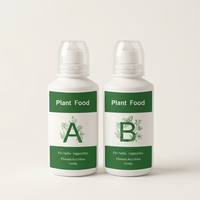
Water is the last piece, and where windowsill pots are hardest to get right in winter. Growing in water instead of compost removes the guesswork — roots have constant access, with no cycle of drying out and drowning.
That combination — a controlled light period, the light held close, roots in nutrient-rich water, sited away from the cold glass — is the whole of what the Gardenia GrowPod does. It is not a substitute for a summer garden. It is a way of having something green and edible on the counter in Salzburg in February, which is the part of the year that has always been the problem.